If someone asked you to describe the Everest region in one word, chances are you’d hesitate.
Not because it’s difficult to explain.
Because it refuses to stay the same.
The Himalayas don’t offer a single experience that lasts from beginning to end. They change with the light, the altitude, the weather, and even the pace at which you walk. A familiar trail in the morning can feel completely different by afternoon. A mountain that seemed distant after breakfast suddenly dominates the skyline by lunchtime.
That’s one of the quiet surprises waiting along the Everest Base Camp Trek with Helicopter Return.
The destination may remain the same.
The journey never does.
6:30 AM — The Mountains Wake Before the Villages
Before the first teahouse serves breakfast, the peaks have already begun their daily transformation.
The highest summits catch the earliest sunlight while the valleys remain wrapped in cool blue shadows. Smoke rises slowly from stone houses as families prepare for another day in the mountains.
There’s no rush.
No traffic.
No background noise competing for attention.
Only crisp air and a landscape slowly revealing itself.
Trekkers often discover that these early hours become their favorite part of the entire day not because anything dramatic happens, but because everything feels wonderfully unhurried.
By Mid-Morning, the Trail Finds Its Rhythm
Walking in the Everest region isn’t a race.
Groups naturally spread out across the trail, each moving at a pace that feels comfortable. Some pause to admire distant peaks. Others stop beside suspension bridges to watch glacial rivers rushing below.
The beauty of the journey lies in these unscripted pauses.
No itinerary can predict which viewpoint will leave the strongest impression or which quiet corner of the trail will become someone’s favorite memory.
The mountains decide that for you.
Lunch Comes With a Different View Every Day
Unlike many vacations where meals blend together, lunch on the Everest trail often introduces a completely new setting.
One afternoon you’re surrounded by dense forests.
The next, you’re looking across wide alpine valleys.
A few days later, rocky terrain replaces greenery as the route climbs toward higher elevations.
Even familiar routines feel different because the scenery never repeats itself.
The changing environment quietly reminds you that progress isn’t measured only by distance.
It’s measured by perspective.
Afternoon Is When the Mountains Reveal Their Scale
Photographs flatten landscapes.
Walking through them does the opposite.
By afternoon, the true size of the Himalayas becomes impossible to ignore.
Peaks rise thousands of meters above the valleys.
Glaciers carve their way through rugged terrain.
Tiny villages appear almost insignificant against the immense backdrop of rock and snow.
For many travelers, this is the moment the Everest region stops feeling like a famous destination and starts feeling like a living mountain world.
Evening Slows Everything Down
As the sun begins to disappear behind distant ridges, conversations naturally become quieter.
Boots are set aside outside teahouse doors.
Warm drinks replace water bottles.
Maps are unfolded across wooden tables while trekkers talk about the day’s highlights.
Nobody seems interested in checking the time.
The schedule that mattered back home fades into the background.
The mountains have their own timetable.
And somehow, everyone adjusts to it.
Then Comes the Unexpected Finale
Most long-distance treks end the same way they begin.
You turn around.
You retrace familiar paths.
You pass the same villages, the same bridges, and the same viewpoints.
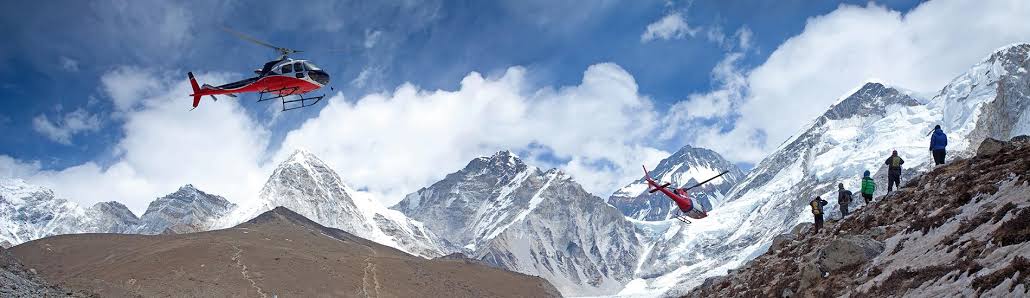
The Everest Base Camp Trek with Helicopter Return changes that rhythm completely.
After days of experiencing the Himalayas one careful step at a time, the return unfolds from above.
The helicopter doesn’t replace the trek—it completes it.
From the air, the winding trails suddenly make sense. Valleys connect like puzzle pieces. Rivers that sounded powerful from nearby become silver ribbons weaving through the mountains. Places that took hours to reach now appear together in a single sweeping panorama.
It’s not just a quicker journey back.
It’s an entirely new way of understanding where you’ve been.
The Moments You Never Plan Become the Ones You Remember
Ask ten trekkers about their favorite memory, and you’ll probably hear ten different answers.
Rarely is it just Everest Base Camp itself.
Someone remembers sharing tea with strangers who became friends by the end of the trek.
Someone else talks about watching clouds drift across Ama Dablam while sitting outside a quiet lodge.
Another recalls laughing with local children in a village where no guidebook suggested stopping.
These aren’t headline attractions.
They’re the moments that happen naturally when you’re not rushing from one landmark to the next.
That’s the quiet beauty of the Everest region it rewards attention more than speed.
Every Traveler Walks Away With a Different Story
Two people can follow the same trail and return with completely different memories.
One may remember the challenge of climbing steep sections.
Another may talk endlessly about the mountain hospitality they experienced in every teahouse.
A photographer might describe changing light across distant peaks.
A wildlife enthusiast may never forget spotting Himalayan birds high above the valleys.
The trail remains the same.
The experience becomes personal.
That’s what gives the Everest journey its lasting appeal.
It doesn’t try to create identical memories for everyone.
It allows each traveler to discover something unique.
Choosing a Journey Designed for the Entire Experience
An unforgettable trek depends on more than reaching a destination.
It depends on thoughtful planning, experienced local guidance, gradual acclimatization, and enough flexibility to appreciate the journey instead of rushing through it.
For travelers looking to experience the Everest Base Camp Trek with Helicopter Return, Mountain Magic Treks offers an itinerary that balances adventure with comfort. The classic trekking route allows you to fully experience the Khumbu region before the scenic helicopter flight reveals the Himalayas from a completely different perspective.
Rather than simply completing the trek, you finish it with one final memory that feels every bit as remarkable as reaching Base Camp itself.
Some Journeys Are Measured in Moments, Not Miles
The distance to Everest Base Camp can be calculated.
The elevation is well documented.
The itinerary fits neatly into a travel plan.
But none of those numbers explain why people continue dreaming about this journey long after they’ve returned home.
What stays with them isn’t a statistic.
It’s the feeling of standing beneath impossibly high mountains.
The quiet confidence built one step at a time.
The conversations shared over warm meals after long days on the trail.
The changing light.
The crisp mountain air.
The final helicopter flight revealing everything from a perspective impossible to appreciate from the ground.
That’s why the Everest Base Camp Trek with Helicopter Return continues to stand apart.
It isn’t just a route across the Himalayas.
It’s a collection of moments that gradually become a story you’ll tell for years.
Frequently Asked Questions
Is the helicopter used for the entire Everest trek?
No. Trekkers follow the traditional route to Everest Base Camp on foot. The helicopter is used for the return journey after completing the trek.
Does the scenery change throughout the trek?
Yes. The route passes through forests, mountain villages, alpine valleys, rocky terrain, and glacial landscapes, offering different views almost every day.
Why do many travelers choose the helicopter return?
It allows them to avoid retracing the same trail while enjoying spectacular aerial views of the Everest region.
Is this trek suitable for experienced and first-time Himalayan trekkers?
With proper preparation, acclimatization, and guidance from experienced trekking professionals, both first-time Himalayan trekkers and experienced hikers can enjoy the journey.
What makes the Everest Base Camp Trek with Helicopter Return unique?
It combines the achievement of reaching Everest Base Camp on foot with a breathtaking helicopter flight that provides a completely different perspective of the Khumbu Valley and surrounding Himalayan peaks.